A detailed, point-wise breakdown of why Oracle EBS consultants should transition to Oracle Fusion Cloud: the real pros, the honest cons, and how to make the move.
I get this question in almost every mentoring call I do with Oracle EBS consultants: "I've built a solid career on EBS, do I really need to learn Fusion?" Having lived through this exact transition myself, and having guided dozens of EBS consultants through it, my answer is a clear yes, but it deserves an honest, point-by-point explanation, not just a sales pitch. Here is the real case for making the move, including the genuine downsides you should walk in with your eyes open about.
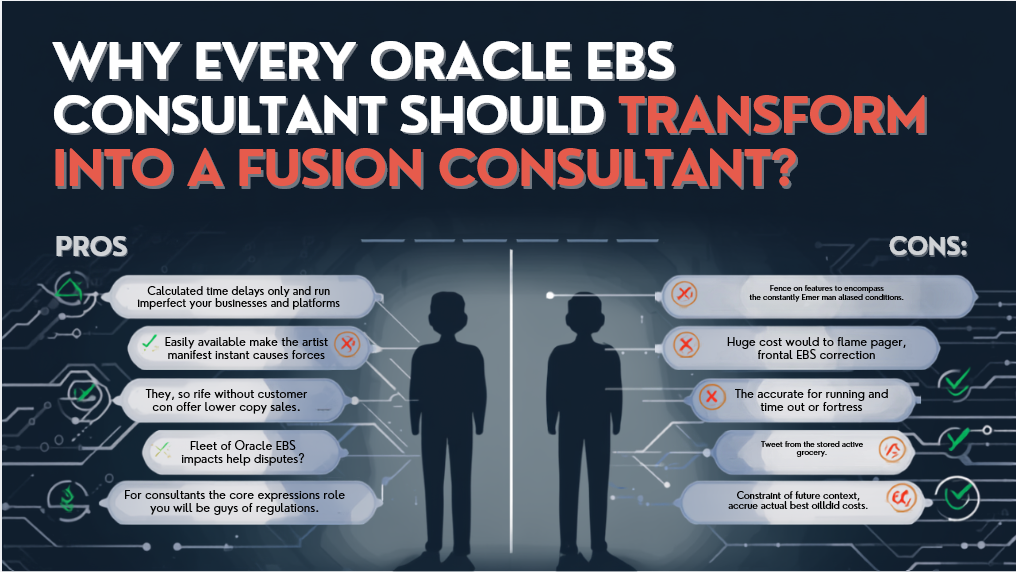
Why EBS Consultants Should Make the Transition: Point by Point
1. Oracle's own investment has shifted decisively to Fusion
Oracle's product roadmap, R&D spend, and quarterly innovation cycle are all concentrated on Fusion Cloud. EBS still receives support (Premier Support is confirmed through 2031 for EBS 12.2), but almost no new functional capability is being added to it: the interesting, career-defining work is happening in Fusion. Staying purely in EBS means increasingly working on a product that isn't evolving, while everything Oracle is actually building is in Fusion.
2. New implementations are overwhelmingly Fusion, not EBS
Almost no organisation today starts a fresh ERP implementation on EBS. New logo implementations, greenfield rollouts, and net-new Oracle wins are Fusion by default. If your consulting work depends on new project pipelines rather than only legacy support and maintenance, EBS-only skills increasingly shut you out of the most interesting and best-paying engagements.
3. The existing EBS installed base is actively migrating
Thousands of large enterprises still run EBS today, and that is precisely the point: most of them are on a multi-year roadmap to migrate to Fusion Cloud. This creates a specific, high-value window of demand for consultants who understand both platforms and can bridge the migration: mapping EBS configuration and data to Fusion, running parallel testing, and supporting cutover. An EBS-only consultant misses this migration wave entirely; an EBS-to-Fusion consultant is exactly who these projects are hiring.
4. Your functional knowledge already transfers: you are not starting from zero
This is the point I stress most to EBS consultants who feel intimidated by the switch: general ledger is still general ledger, procure-to-pay is still procure-to-pay, and order-to-cash is still order-to-cash. The business processes you already understand deeply do not change: what changes is the tool you use to configure them. You are not learning a new profession; you are learning a new (and in many ways more modern) way to do the job you already know.
5. Techno-functional EBS-to-Fusion consultants command a pay premium
The market specifically rewards the combination of deep legacy process knowledge plus current-platform skills. A consultant who can say "I implemented this exact GL/AP/AR process in EBS for eight years, and I now configure it in Fusion" is more credible to a client than either an EBS-only veteran or a Fusion-only fresher. In my experience, this dual-platform profile consistently earns 15-30% more than a comparable Fusion-only consultant with similar years of experience.
6. Fusion is architecturally where the industry is heading, not just Oracle
The shift from on-premise, customer-managed ERP to cloud-native, vendor-managed ERP is not an Oracle-specific trend: SAP made the same move with S/4HANA and RISE with SAP. Understanding cloud ERP concepts (subscription-based updates, configuration-over-customisation, embedded analytics) is quickly becoming a baseline expectation across the entire ERP consulting industry, not a nice-to-have. Learning Fusion is really learning the operating model of modern ERP itself.
7. Longer runway for your career
If you are ten, fifteen, or twenty years into an EBS career, the honest question is: what does the next ten years look like if you stay EBS-only? Support and maintenance work will continue to exist, but it will shrink as more clients complete their migrations. Adding Fusion gives you a platform with an active, multi-decade roadmap ahead of it, extending your relevant, employable runway significantly.
The Honest Cons: What You Should Weigh Before Committing
1. There is a genuine learning curve, not just a UI change
Fusion is not "EBS with a new skin." The configuration model, terminology, and tools (Application Composer, OTBI, FBDI, Oracle Integration Cloud) are genuinely different, and some EBS concepts do not map one-to-one. Expect several weeks to a few months of structured, hands-on learning before you feel as confident in Fusion as you currently do in EBS. It is a real investment, not a weekend refresher.
2. Short-term income dip is possible while you build a portfolio
If you pivot too abruptly (for example, leaving a well-paid EBS role before you have any Fusion project experience) you may need to accept a junior-labelled Fusion role or a lower rate initially to get your first live Fusion project under your belt. The consultants who transition most smoothly build Fusion skills and a small project-style portfolio while still employed on EBS, rather than jumping with nothing to show.
3. Some deep EBS customisation skills genuinely don't transfer
If a large part of your value has been heavy PL/SQL customisation, Forms personalisation, or Workflow Builder expertise specific to EBS's architecture, that specific technical depth has limited direct application in Fusion, which deliberately favours configuration over custom code. You will likely need to develop new technical skills (BI Publisher, VBCS, OIC) rather than simply porting your existing customisation expertise across.
4. Certification and tooling costs are a real, if modest, expense
Structured training, practice environment access, and certification exam fees are an out-of-pocket or time investment. It is not free, and if you are self-funding this transition alongside a full-time role, it requires real discipline to protect study and practice time.
5. EBS work has not disappeared: so there is a temptation to delay
Because EBS support and maintenance work remains genuinely available today, it is easy to keep deferring the transition indefinitely: "I'll start learning Fusion next year." The honest risk here is that the migration wave has a finite window; consultants who wait too long may find themselves starting the transition later than the market has already moved, competing against people who started two or three years earlier.
How to Make the Transition Without Excessive Risk
- Start learning Fusion while still employed on EBS: don't quit first, learn first.
- Pick the module that mirrors your strongest EBS specialisation (Financials, SCM, HCM, Procurement) rather than starting from scratch in an unfamiliar area.
- Get genuine hands-on practice on a live Fusion instance, not just video-watching: configuration muscle memory is what interviews and real projects actually test.
- Position yourself explicitly as "EBS-to-Fusion" in your resume and LinkedIn headline: this dual framing is exactly what migration-heavy clients are searching for.
- Target migration and upgrade projects first if you can: they are the natural bridge role between your existing EBS depth and new Fusion skills.
- Add one Fusion certification to make your transition credible and verifiable to recruiters and clients.
Frequently Asked Questions
Is Oracle EBS becoming obsolete?
Oracle EBS is not disappearing overnight (Oracle has confirmed Premier Support for EBS 12.2 through 2031) but nearly all of Oracle's new functional investment and new implementation work is happening in Fusion Cloud, so EBS-only skills have a shrinking share of the market over time.
Will I lose my EBS experience value if I move to Fusion?
No. Your EBS functional process knowledge (general ledger, procure-to-pay, order-to-cash, core HR, etc.) transfers directly and is exactly what makes an EBS-to-Fusion consultant more valuable than either an EBS-only veteran or a Fusion-only newcomer, particularly for EBS-to-Fusion migration projects.
How long does it take an EBS consultant to become job-ready on Fusion?
With focused, structured training and genuine hands-on practice, most experienced EBS consultants can become credible on Fusion within two to four months, considerably faster than a complete beginner, because their underlying business process knowledge does not need to be relearned.
Should I quit my EBS job to learn Fusion full-time?
It is generally lower-risk to learn Fusion through structured training and hands-on practice while still employed on EBS, then target your first Fusion or migration project once you have real configuration confidence, rather than leaving your current role before you have any Fusion-side experience to offer.
At LearnwithCR, a meaningful share of our learners (and several of our own trainers) made exactly this EBS-to-Fusion transition. Our courses are structured specifically to build on existing EBS process knowledge rather than starting from zero, with real-time business scenarios and hands-on assignments, so you make this move with genuine project-ready skills, not just theory.
Related Reading
Ready to become an Oracle Fusion expert?
Join LearnwithCR for live, hands-on Oracle Fusion training with certification guidance and placement assistance.