
The close is not really a three-day or five-day event. It's a thirty-day process whose problems are usually discovered in the final few days. Here's where Oracle Fusion's Ledger Agent can actually change that, and where it can't.
Anyone who has worked through an Oracle Fusion Financials close knows the pattern. Accountants run reports, download data, compare balances, investigate unusual movements, contact business teams, wait for explanations and prepare adjustment journals. The application may be fully integrated, but the investigation surrounding the close can still depend heavily on spreadsheets, emails and individual experience.
That is the business problem Oracle's Ledger Agent is trying to address.
In the earlier LearnwithCR introduction to the Oracle Fusion Ledger Agent, we looked at its role in journals, reconciliation and period-close activities. This article goes one level deeper: where does the Ledger Agent create real business value, what should finance leaders expect from it, and how should a Fusion implementation team introduce it without weakening financial control?
What Oracle has actually announced
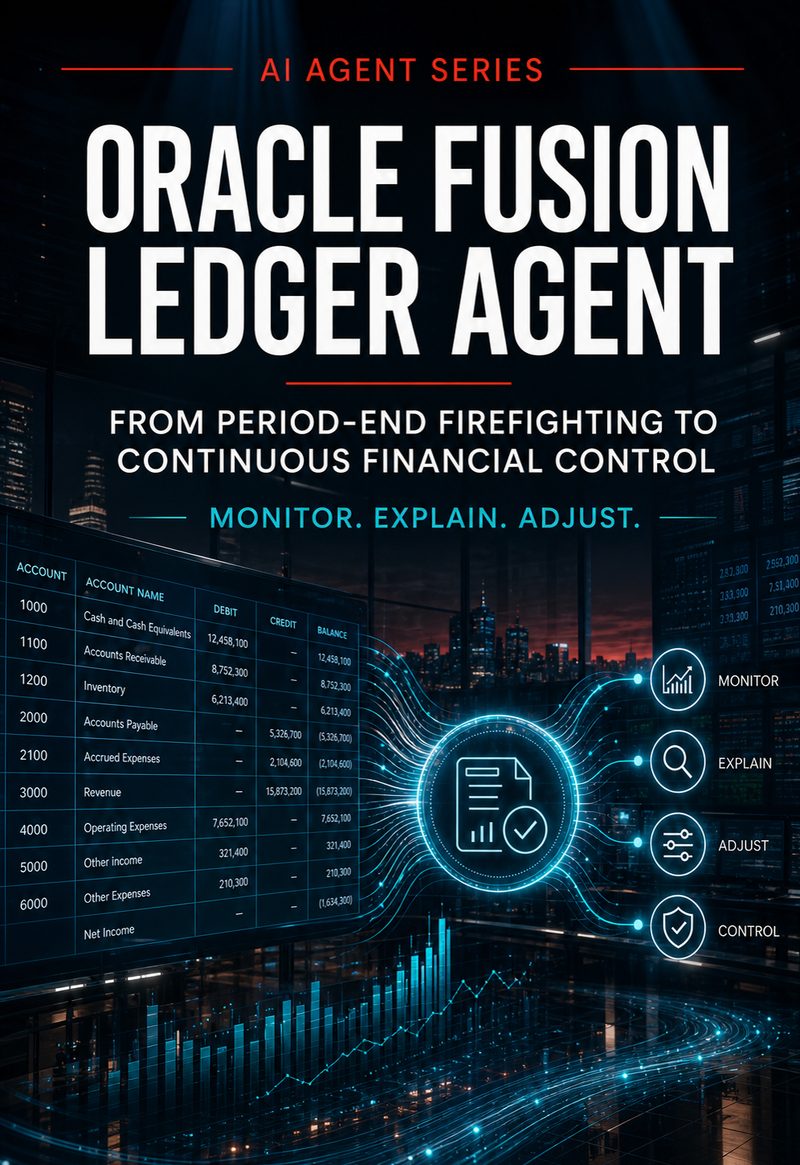
Oracle describes the Ledger Agent as a way for accountants to move from report chasing to continuous insight and action. The announced capabilities are significant. Oracle says the agent can:
- Set monitoring prompts using natural language.
- Provide context-aware account inquiry and explanations with supporting details.
- Automatically create adjustment journals.
- Help accelerate issue resolution.
- Reduce handoffs between finance users.
- Improve accounting accuracy.
- Provide more continuous visibility into financial activity.
These capabilities place the Ledger Agent much closer to the daily work of a GL accountant than a generic conversational assistant. It is not simply answering “where do I find the trial balance?” It is intended to operate in the context of the ledger, the account activity and the finance process.
That distinction matters. A generic assistant helps a user navigate. A ledger-focused agent helps the user understand what changed, decide what deserves attention and move the issue towards resolution.
The real problem is not a lack of reports
Oracle Fusion already provides strong inquiry, reporting and drill-down capabilities. Most finance teams are not short of reports. The problem is the effort required to turn those reports into a conclusion.
A controller does not only need to know that an expense account increased by 18 percent. The useful questions are:
- Which legal entities or cost centres caused the increase?
- Is the movement supported by business activity?
- Is it a timing difference, an incorrect account or an incomplete accrual?
- Did the same pattern occur in the previous period?
- Does the issue require an adjustment?
- Who needs to review the adjustment?
- Can the matter be resolved before the close becomes critical?
Traditionally, answering these questions means moving between account analysis, journals, subledger reports, spreadsheets and conversations with other teams. The Ledger Agent has the potential to shorten that journey by keeping inquiry, explanation and action closer together.
Business use case one: continuous account monitoring
Most organisations still treat account review as a scheduled close activity. Accountants begin detailed analysis when the close calendar tells them to begin. Natural-language monitoring changes that model.
A finance team could define business-focused monitoring requirements such as:
- Highlight unusual movements in selected operating-expense accounts.
- Identify balances that move outside an agreed materiality range.
- Monitor clearing accounts that should normally return to zero.
- Surface unexpected activity in accounts that are usually dormant.
- Draw attention to significant movements close to the period end.
These examples illustrate the type of monitoring design a finance team could consider. The precise prompts and supported actions must be validated in the organisation's Oracle release and environment.
The value does not come from receiving more alerts. Finance teams already have enough notifications. The value comes from identifying an issue while there is still time to resolve it. If a clearing account starts accumulating an unexpected balance on day twelve, it is better to investigate on day twelve than on close day two. The issue is the same, but the operational cost is very different.
This is the first major business benefit of the Ledger Agent: it can help move the organisation from period-end detection towards continuous financial control.
Business use case two: faster variance investigation
A variance is rarely difficult because it exists. It is difficult because the accountant must establish its cause. Consider a regional freight-expense account that is materially above forecast. A traditional investigation might involve:
- 1. Running an account analysis.
- 2. Exporting the transactions.
- 3. Grouping them by business unit, supplier or cost centre.
- 4. Comparing the result with the previous period.
- 5. Reviewing the underlying journals or subledger entries.
- 6. Contacting the responsible business team.
- 7. Documenting the explanation for the controller.
Oracle says the Ledger Agent can provide context-aware inquiry and explanations with supporting details. Applied well, this could reduce the manual work between identifying the variance and understanding its drivers.
The accountant still owns the conclusion. The agent shortens the path to the evidence. That difference is important. Finance should not adopt the Ledger Agent to avoid professional judgement. It should adopt it to prevent skilled accountants from spending hours collecting information before they can apply that judgement.
Business use case three: adjustment journals with control
Oracle also states that the Ledger Agent can automatically create adjustment journals. This is where the business opportunity becomes larger, but so does the need for design discipline.
Finding an issue and preparing the correcting journal are closely connected activities. If the agent can use the inquiry context to prepare an adjustment, the accountant may no longer need to re-enter the same account, entity, amount, description and supporting rationale manually. That can reduce:
- Re-keying errors.
- Incomplete journal descriptions.
- Incorrect account combinations.
- Delays between investigation and correction.
- Repeated explanations across email, spreadsheets and journal attachments.
However, automatic creation must not be confused with uncontrolled posting. A sound solution should retain the organisation's established controls around journal approval, posting, segregation of duties, supporting documentation, accounting periods and data access. The Ledger Agent should work inside the control framework, not become a route around it.
From an architecture perspective, the safest early use case is usually controlled journal preparation. The agent helps prepare a complete adjustment with supporting context; the authorised accountant reviews it; the existing approval and posting process continues to operate. As confidence grows, the organisation can decide whether any tightly defined, low-risk adjustments justify a higher degree of automation.
What changes for the finance team
The Ledger Agent does not remove the accountant from the close. It changes where the accountant spends time. Without the agent, a large portion of the close may be spent gathering information:
- Running standard reports.
- Repeating the same account analysis.
- Matching movements across periods.
- Writing explanations.
- Chasing another team for context.
- Preparing routine adjustments.
With the agent, more of the accountant's time can move towards:
- Evaluating whether an explanation is commercially reasonable.
- Deciding whether a variance requires action.
- Reviewing the accounting treatment.
- Challenging unusual business activity.
- Assessing materiality.
- Confirming that an adjustment is complete and controlled.
- Communicating the financial impact to management.
This is not a smaller finance role. It is a more judgement-intensive one.
A practical month-end example
Take a manufacturing group with multiple legal entities and a centralised finance team. During the final week of the month, the Ledger Agent identifies that a maintenance-expense account in one plant is moving outside its normal range. The accountant asks for the transactions contributing most to the movement and requests a comparison with recent periods.
The supporting detail shows that several invoices normally charged to a capital project have been posted to maintenance expense. The accountant reviews the transactions and confirms the issue with the plant finance manager.
An adjustment journal is prepared with the relevant account combination, amount and explanation. The accountant validates the proposed accounting, attaches or references the supporting evidence and sends the journal through the existing approval process.
Without this flow, the issue may have been found during close, after reports were distributed and when the finance team was already working through a large exception list. The accounting result is the same. The difference is when the issue is detected, how quickly its cause is understood and how much manual effort is required to correct it.
Where the business value comes from
The Ledger Agent's value should not be measured by the number of conversations users have with it. That is an activity measure, not a business outcome. A useful business case should focus on five areas.
Earlier issue detection
Measure how many material issues are identified before the formal close window begins. The objective is to reduce late surprises, not merely produce faster answers after a surprise occurs.
Shorter investigation time
Track the average time between identifying an unusual balance and documenting a supported explanation. This is one of the clearest areas in which context-aware inquiry can help.
Fewer manual handoffs
Measure how often an accountant must move an issue through spreadsheets, email and offline analysis before reaching a conclusion. A reduced number of handoffs usually means a more reliable close process.
Better journal quality
Track journal rejections, incomplete descriptions, incorrect account combinations and adjustments returned for additional support. If the agent helps prepare adjustments, journal quality should improve rather than only journal volume.
A more predictable close
Monitor close duration, late adjustments and post-close corrections. The longer-term objective is not simply to make accountants work faster during the close; it is to make the close less volatile.
What the Ledger Agent will not fix
There is a temptation to place new technology on top of an old process and expect the process to become intelligent. That rarely works. The Ledger Agent will not correct:
- A poorly designed chart of accounts.
- Inconsistent use of cost centres or balancing segments.
- Weak journal governance.
- Unreconciled subledgers.
- Incorrectly assigned data access.
- Duplicate or conflicting reports.
- Missing ownership for account reconciliations.
- A close calendar that nobody follows.
- Poor-quality source data from integrations.
An agent can accelerate a good process. It can also expose the weaknesses of a bad one much faster. Before implementation, the solution architect should confirm that the ledger structure, account ownership, materiality rules, security model and approval framework are ready to support agent-assisted work.
The control model matters as much as the capability
For a finance function, trust is not established through a demonstration. It is established through repeatable control. A Ledger Agent design should answer the following questions before production use:
- Which ledgers and balancing-segment values can each user access?
- Which accounts can be monitored?
- Who defines and approves monitoring prompts?
- What supporting details are presented with an explanation?
- How does a user distinguish sourced information from an interpretation?
- Under what conditions can an adjustment journal be created?
- Which journal sources and categories should be used?
- Does the normal approval workflow remain mandatory?
- Who can post the resulting journal?
- How are rejected recommendations reviewed?
- How will the organisation audit agent-assisted activity?
- What is the fallback process when the agent cannot reach a reliable conclusion?
If these questions are postponed until testing, the organisation is testing a feature rather than designing a controlled finance process.
A sensible implementation roadmap
The Ledger Agent should be introduced in stages.
Stage one: establish the baseline
Document the present close process. Measure investigation time, late adjustments, journal rejection rates, manual report runs and the number of unresolved issues entering the close window. Without this baseline, it will be difficult to prove whether the agent created value.
Stage two: begin with observation
Start with a limited set of high-value accounts and use the agent for monitoring and inquiry. Avoid trying to cover the complete chart of accounts. Good candidates are accounts with clear ownership, repeatable review criteria and enough transaction volume to demonstrate value.
Stage three: introduce assisted investigation
Allow selected accountants to use contextual inquiry and explanations. Compare the result with the existing investigation process and require users to validate the supporting details. This stage builds confidence in the evidence, not just the wording of the explanation.
Stage four: introduce controlled journal preparation
Use the agent to prepare adjustment journals for defined scenarios while retaining human review, approval and posting controls. Track the quality of the journals and the reasons for any rejection.
Stage five: expand based on evidence
Extend the scope only after the pilot demonstrates shorter investigation times, earlier issue detection and acceptable control performance. Do not scale because the demonstration was impressive. Scale because the operating evidence is convincing.
Questions a CFO should ask before approving the initiative
A CFO does not need a technical presentation on language models. The useful questions are practical:
- Which part of our close becomes faster?
- Which existing control remains responsible for approving an adjustment?
- What evidence will accompany an explanation?
- How will we measure fewer late surprises?
- What happens when the agent is uncertain?
- Can access be restricted by ledger and business responsibility?
- How will internal and external auditors review the process?
- What is our plan if the results are not reliable enough?
- Which finance roles will change, and how will those people be trained?
A strong implementation team should be able to answer these questions without hiding behind product terminology.
What this means for Oracle Fusion consultants
For consultants, the Ledger Agent creates a new design responsibility. Knowing the General Ledger setup remains essential. In fact, it becomes more important because the consultant must understand how account structures, journal controls, data access sets, approvals, close activities and integrations influence what the agent can safely do.
The work is no longer limited to enabling a feature. Consultants must help the business define:
- The right monitoring use cases.
- The materiality and escalation rules.
- The boundary between assistance and autonomous action.
- The evidence required for journal support.
- The approval and posting model.
- The measures used to prove business value.
- The change-management plan for accountants and controllers.
This is where functional depth and solution architecture meet.
Frequently Asked Questions
What is Oracle Fusion Ledger Agent?
Oracle describes Ledger Agent as an AI agent for accountants that supports natural-language monitoring, context-aware inquiry and explanations with supporting details, and the automatic creation of adjustment journals.
How can Ledger Agent help during period close?
It can help finance teams identify unusual activity earlier, investigate account movements with supporting context and move confirmed issues towards adjustment. Its broader value is shifting work from late report chasing towards continuous financial visibility.
Does Ledger Agent post journals without approval?
Oracle has announced automatic creation of adjustment journals. Each organisation should confirm the exact behaviour available in its release and retain appropriate journal approval, segregation-of-duties and posting controls.
Will Ledger Agent replace accountants?
It is more likely to change how accountants spend their time. Routine information gathering and journal preparation can reduce, while review, accounting judgement, materiality assessment, control and business explanation remain human responsibilities.
Which accounts should be used in the first pilot?
Start with accounts that have clear ownership, repeatable review rules, sufficient activity and a history of time-consuming investigation. Avoid beginning with the most complex or judgement-heavy accounting area.
How should a business measure success?
Useful measures include time to investigate a variance, issues found before the close window, journal rejection rates, late adjustments, post-close corrections and the overall predictability of the close.
The bottom line
The Ledger Agent should not be positioned as a smarter way to ask for a report. Its real potential is to connect three activities that finance teams often perform separately: monitoring the ledger, understanding what changed and taking controlled corrective action.
For the business, that means earlier visibility, fewer handoffs, faster resolution and a more predictable close. For the finance team, it means less time gathering evidence and more time applying judgement.
For the Oracle Fusion consultant, it means designing not only what the agent can do, but what it should be allowed to do, how its work will be reviewed and how the organisation will prove that the process remains controlled.
That is the point at which Ledger Agent becomes more than an interesting feature. It becomes part of the finance operating model.
Source
Oracle Advances Enterprise AI with New Agents Across Fusion Applications, Oracle, October 2025.
Related Reading
Official reference: Oracle Fusion Cloud Financials (official)
Ready to become an Oracle Fusion expert?
Join LearnwithCR for live, hands-on Oracle Fusion training with certification guidance and placement assistance.